d@:taLog Studio
Digital Catalog displaying my curated jewellery collection
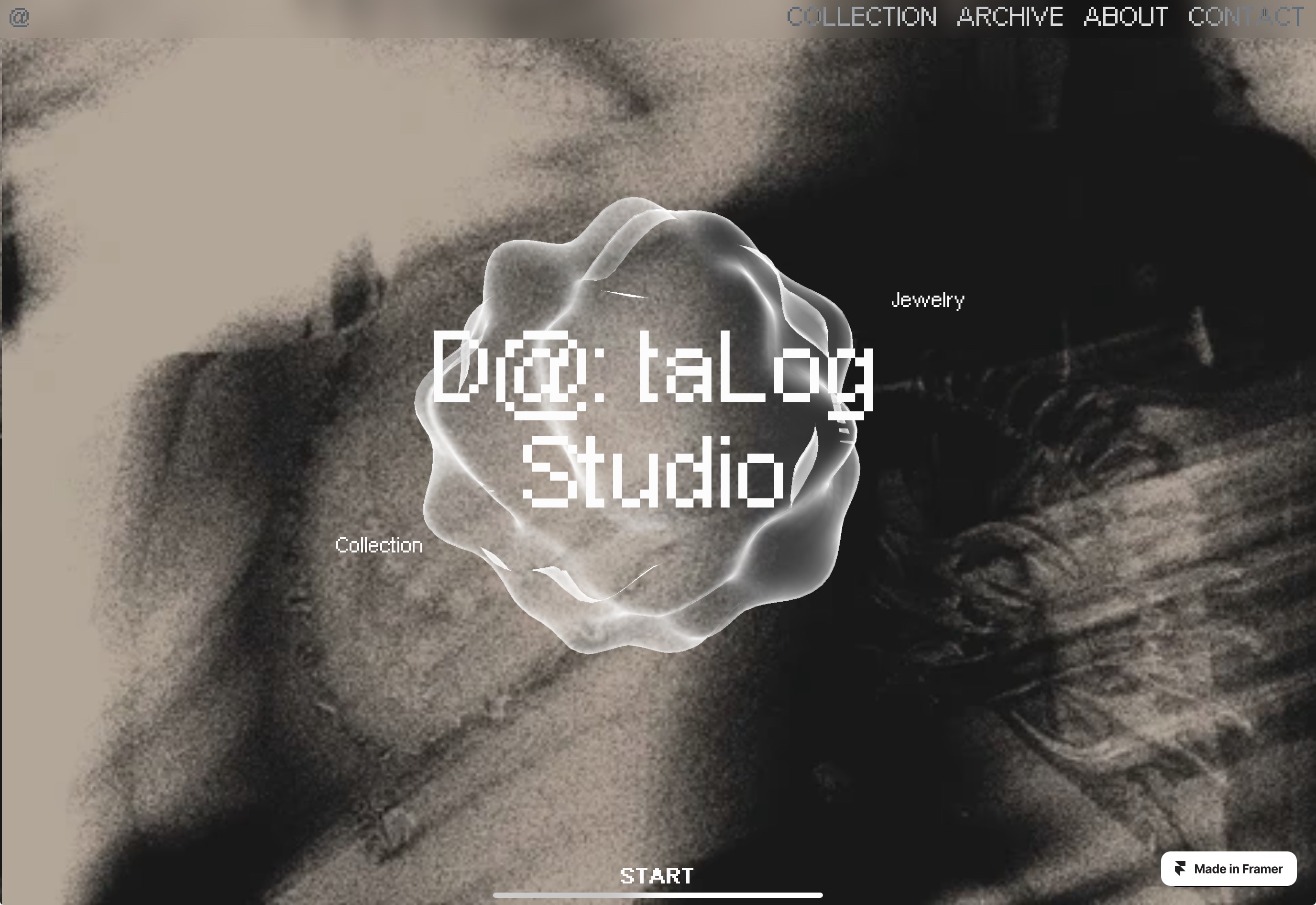
In Short
A digital catalogue made specifically to log my jewelry collection starting from the year 2018. This website was made from the love I feel towards my pieces but also as a means to keep track of my collection and share it with other people. Sadly I was not able to keep and record all of my accessories, so a few have been lost in time.
Link to the website: https://datalog-studio.framer.website
Product:
Product:
Web Design
Web Design
Year:
Year:
2025
2025
Role:
Role:
UI/UX Design, Web development
UI/UX Design, Web development
Skills:
Skills:
No-code web design
No-code web design
Key screens
The
Problem
As a jewellery creator, I noticed that my pieces didn’t have a dedicated home where users could explore them in a structured, visually engaging way. Existing platforms didn’t allow me to present the collection with the clarity and creative expression I wanted users to experience.
Solution
Overview
I built “d@:talog” as a dedicated digital home for my jewellery collection—a space where users can explore each piece in a visually rich and easy-to-navigate format. The project allowed me to combine design, storytelling, and functional UX principles while learning Framer in a hands-on way.
The
Research
To inform the design of my jewelry catalog website, I conducted competitive benchmarking by analyzing several online jewelry stores and independent designer websites. This process helped me identify common layout patterns, navigational structures, and visual approaches that effectively highlight product aesthetics while maintaining user engagement. Through this analysis, I was able to define a layout that allows each jewelry piece to stand out while preserving a clean and visually appealing interface.
As this was a self-initiated project, I positioned myself as both the designer and target user, focusing on individuals who view jewelry not only as accessories but as items with personal and emotional meaning. My research emphasized finding a balance between storytelling and simplicity, ensuring the design communicates authenticity and individuality. The project was also an exploration of no-code website creation, aiming to combine aesthetic quality with accessibility and usability.
Key
Insights
Simplicity Wins
Competitive benchmarking of other jewellery sites showed that cluttered layouts, too many navigation options, or overly flashy UI distract from the jewellery itself. A clean, minimal interface allows each piece to shine.
Emotional Connection Matters
As both the designer and target user, you realized that jewellery isn’t just about aesthetics — it’s deeply personal. Users (including yourself) want to see stories or “backgrounds” behind pieces, not just product photos.
The
Challenge
How might we create an intuitive and visually engaging online experience that helps users easily explore and connect with a jewelry collection?
The
Ideation Process
After gathering notes on the design patterns used across various jewellery websites, I began developing a concept and mood board on Pinterest to define the desired visual direction. I curated a collection of images that reflected the atmosphere and aesthetic I wanted to achieve: clean, elegant, and refined—where the metallic qualities of the jewellery pieces could take centre stage as the main visual focus of the site.
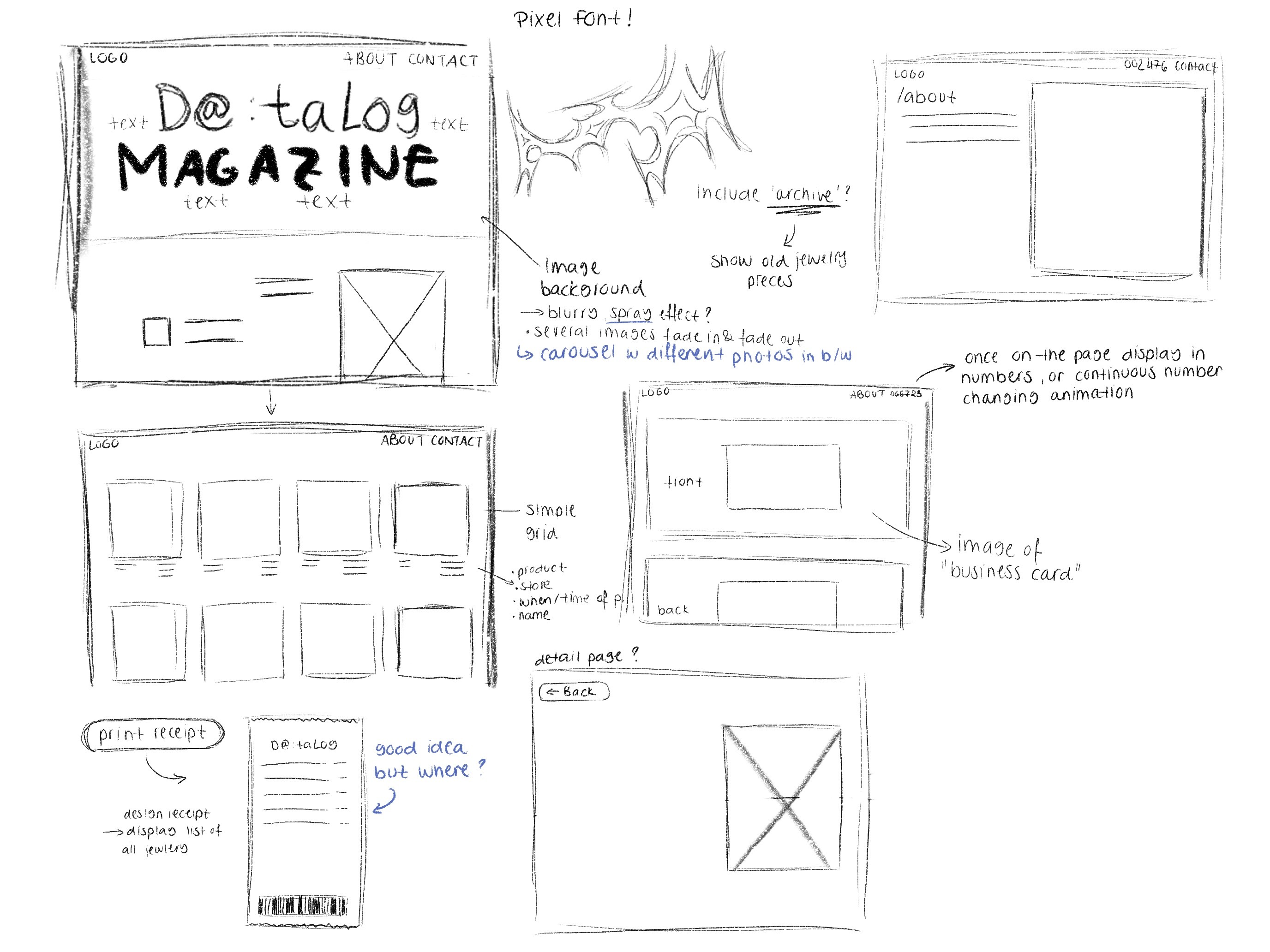
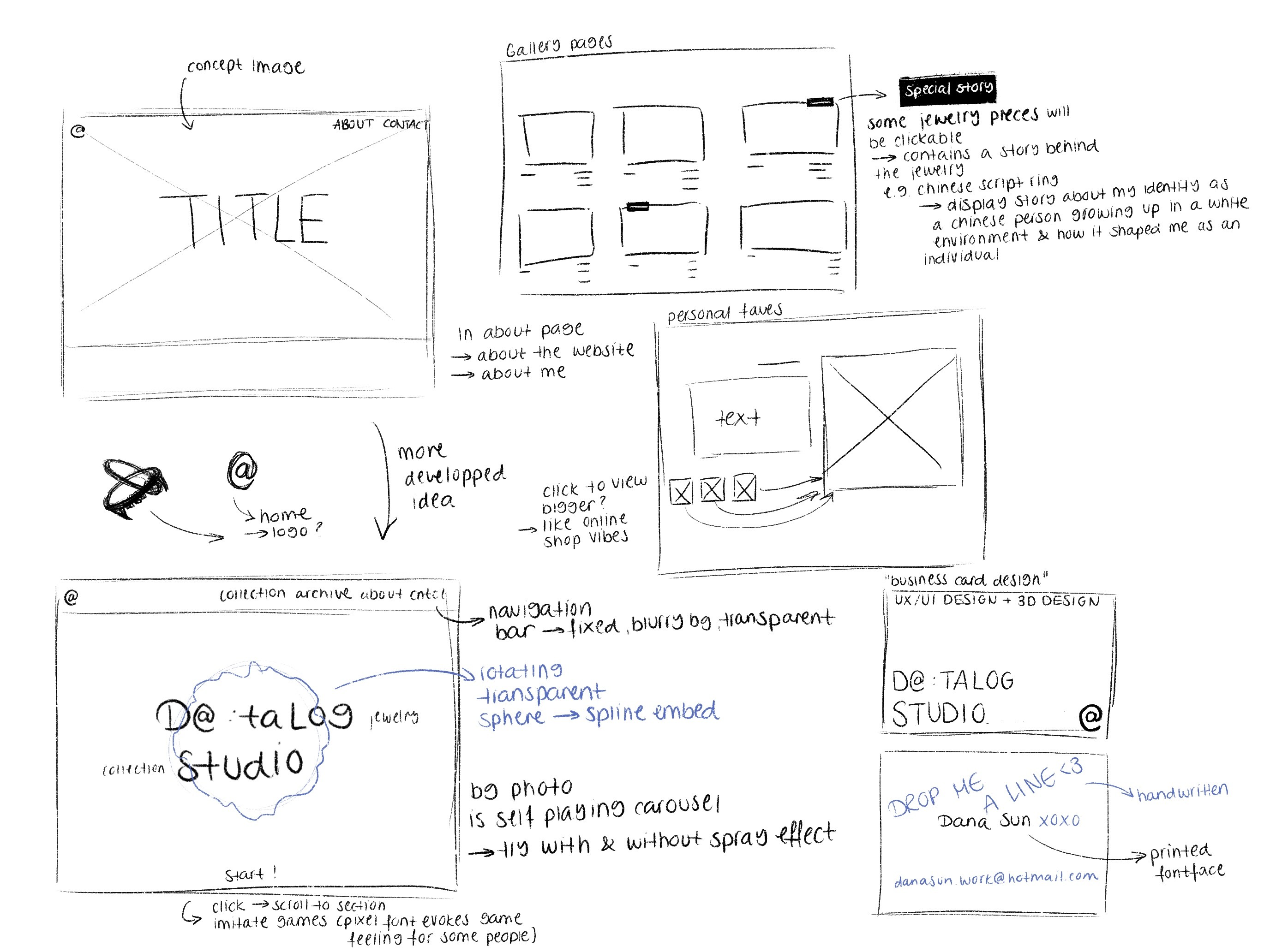
With this concept established, I proceeded to sketch different layout variations for the online catalog. My goal was to create a structure that is simple, intuitive, and visually balanced, while still maintaining an artistic and curated feel that aligns with the catalog’s identity. This phase helped translate the abstract mood and inspiration into tangible design ideas ready for digital prototyping.
The
Low Fidelity Prototype
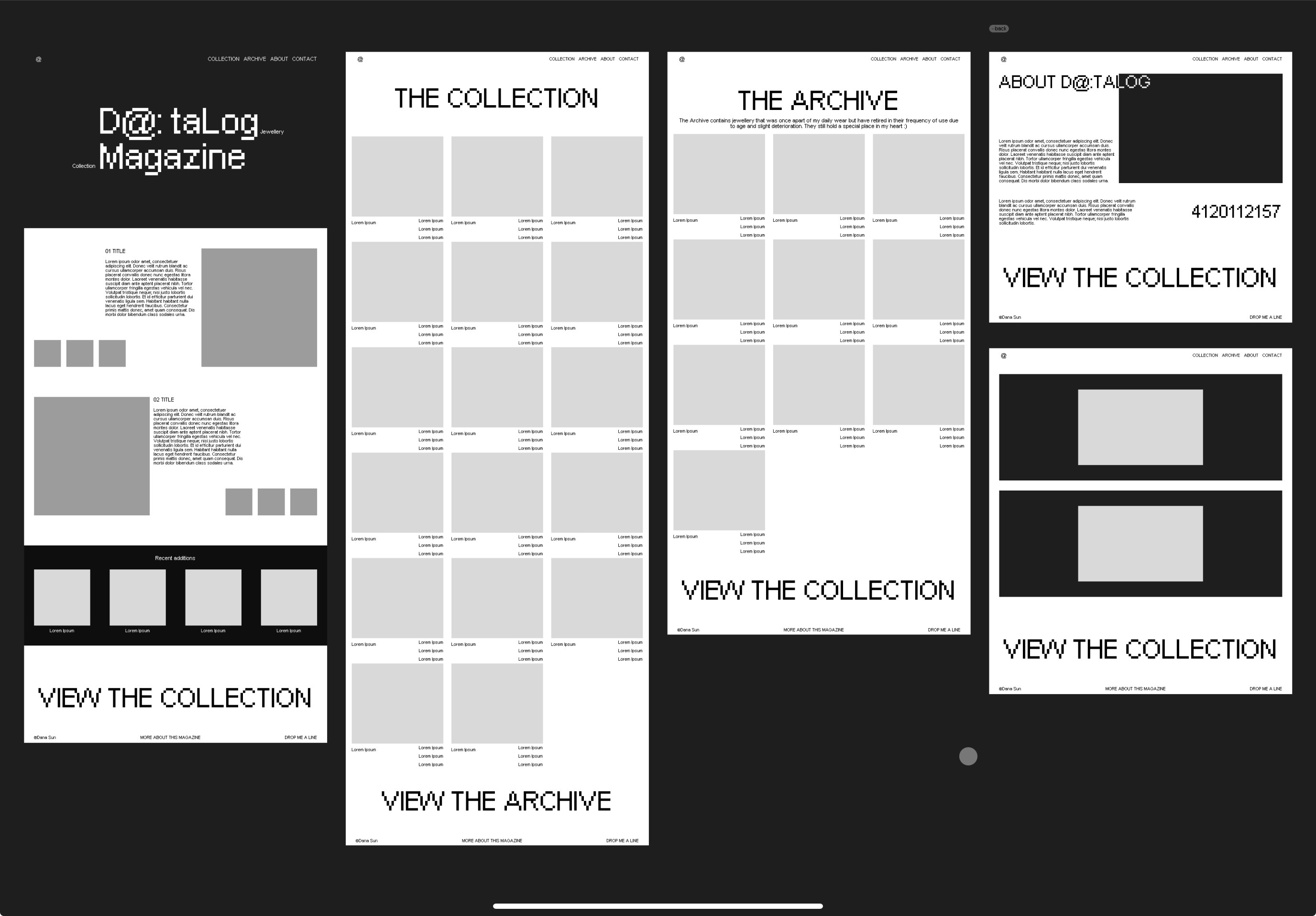
Once I finalized a layout concept, I began creating the wireframes in Figma, using grey placeholder blocks to establish the structure and hierarchy of each section. After completing the first version, I gathered informal user feedback from a few peers to understand their initial impressions. The responses were largely positive where participants found the layout clear and easy to navigate.
One design element I was initially uncertain about was the use of a pixel-style font, which introduced a playful, game-like quality to the interface. However, the feedback confirmed that this stylistic choice resonated well with viewers, adding a distinctive and memorable touch to the otherwise minimalist design. Based on these insights, I proceeded to develop the high-fidelity prototype in Framer, refining the visual details and interactive elements to bring the concept to life.
The
Solution
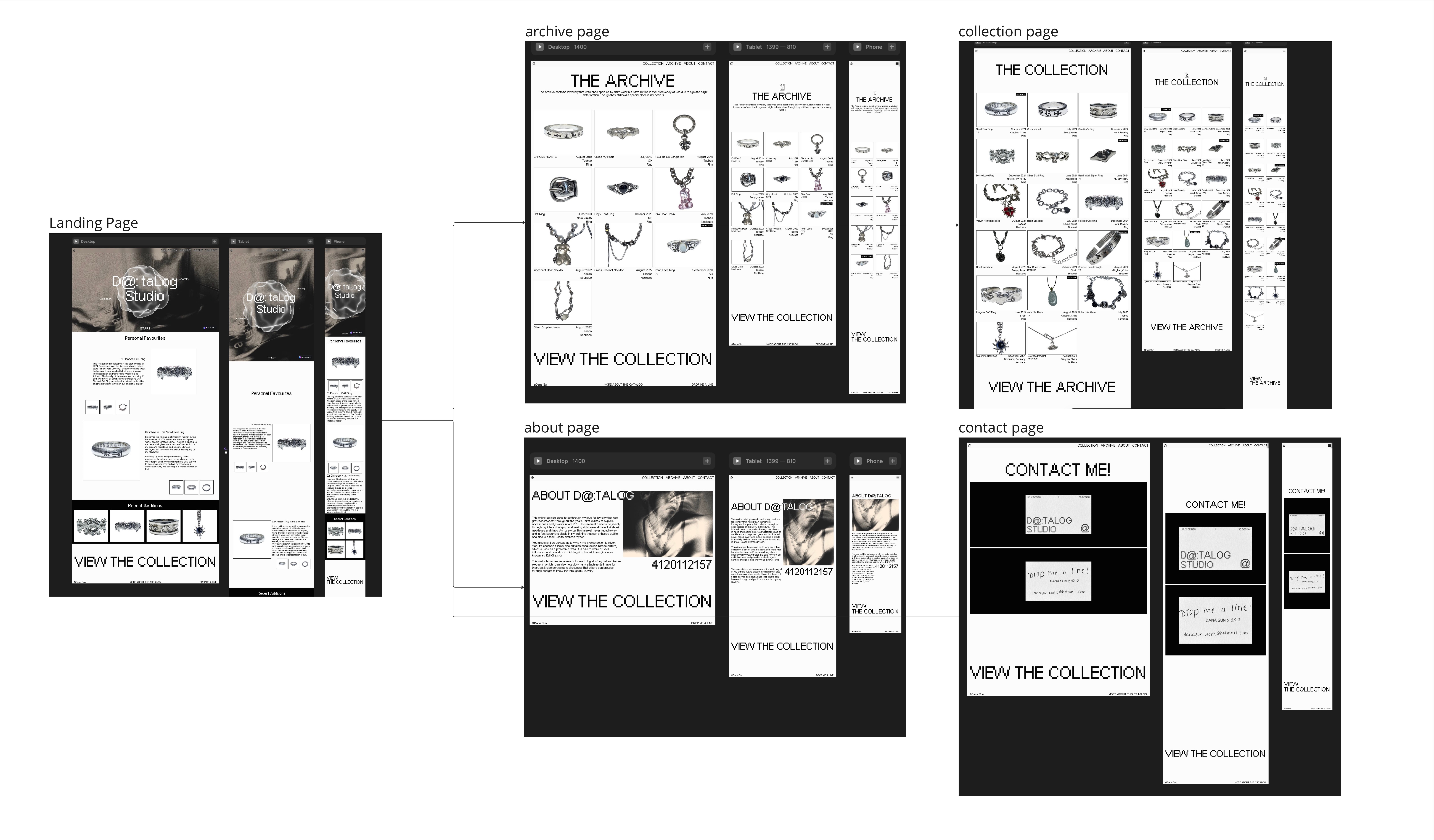
d@:talog is a clean, minimalistic catalog site designed to showcase my curated jewellery collection in a simple and intuitive way. The website uses a streamlined navigation structure that allows users to browse pieces effortlessly and find items without distraction. Built with a CMS-backed setup, it’s easy to maintain and update—new additions can be uploaded and organized quickly, keeping the catalog current without any technical complexity. The design prioritizes clarity, balance, and simplicity, ensuring that the focus remains on the pieces themselves while providing a smooth, user-friendly experience.
Reflection
This was my second time making a no-code website using Framer and I noticed a major difference in my understanding of the software from making my portfolio to making this catalogue website. Overall I had an amazing time with this project and it was so fun to make all the different assets I needed and taking all of the seperate jewellery photos and editing them in photoshop. It was a lot more work than I had initally planned for but I am very proud of the end result. I believe that the website embodies all of the characteristics that I wanted it to and I am very pleased with adding the option for the viewer to read stories behind a few of the pieces. It gives it more character and the viewer can feel a bit more connected to these pieces rather than just seeing them as silver pieces that you can wear.
While I am very satisfied with the end result, I feel that I can do better on the creativity aspect and make the layout and animations a bit more engaging and fun. As of right now my animations are very basic but I want to challenge myself to create something out of the box in my next project. I want to explore different animation effects and transitions that make a website better and feel more alive.
[NEXT PROJECT]
d@:taLog Studio
Digital Catalog displaying my curated jewellery collection
In Short
A digital catalogue made specifically to log my jewelry collection starting from the year 2018. This website was made from the love I feel towards my pieces but also as a means to keep track of my collection and share it with other people. Sadly I was not able to keep and record all of my accessories, so a few have been lost in time.
Link to the website: https://datalog-studio.framer.website
Product:
Web Design
Year:
2025
Role:
UI/UX Design, Web development
Skills:
No-code web design
Key screens
The
Problem
As a jewellery creator, I noticed that my pieces didn’t have a dedicated home where users could explore them in a structured, visually engaging way. Existing platforms didn’t allow me to present the collection with the clarity and creative expression I wanted users to experience.
Solution
Overview
I built “d@:talog” as a dedicated digital home for my jewellery collection—a space where users can explore each piece in a visually rich and easy-to-navigate format. The project allowed me to combine design, storytelling, and functional UX principles while learning Framer in a hands-on way.
The
Research
To inform the design of my jewelry catalog website, I conducted competitive benchmarking by analyzing several online jewelry stores and independent designer websites. This process helped me identify common layout patterns, navigational structures, and visual approaches that effectively highlight product aesthetics while maintaining user engagement. Through this analysis, I was able to define a layout that allows each jewelry piece to stand out while preserving a clean and visually appealing interface.
As this was a self-initiated project, I positioned myself as both the designer and target user, focusing on individuals who view jewelry not only as accessories but as items with personal and emotional meaning. My research emphasized finding a balance between storytelling and simplicity, ensuring the design communicates authenticity and individuality. The project was also an exploration of no-code website creation, aiming to combine aesthetic quality with accessibility and usability.
Key
Insights
Simplicity Wins
Competitive benchmarking of other jewellery sites showed that cluttered layouts, too many navigation options, or overly flashy UI distract from the jewellery itself. A clean, minimal interface allows each piece to shine.
Emotional Connection Matters
As both the designer and target user, you realized that jewellery isn’t just about aesthetics — it’s deeply personal. Users (including yourself) want to see stories or “backgrounds” behind pieces, not just product photos.
The
Challenge
How might we create an intuitive and visually engaging online experience that helps users easily explore and connect with a jewelry collection?
The
Ideation Process
After gathering notes on the design patterns used across various jewellery websites, I began developing a concept and mood board on Pinterest to define the desired visual direction. I curated a collection of images that reflected the atmosphere and aesthetic I wanted to achieve: clean, elegant, and refined—where the metallic qualities of the jewellery pieces could take centre stage as the main visual focus of the site.
With this concept established, I proceeded to sketch different layout variations for the online catalog. My goal was to create a structure that is simple, intuitive, and visually balanced, while still maintaining an artistic and curated feel that aligns with the catalog’s identity. This phase helped translate the abstract mood and inspiration into tangible design ideas ready for digital prototyping.
The
Low Fidelity Prototype
Once I finalized a layout concept, I began creating the wireframes in Figma, using grey placeholder blocks to establish the structure and hierarchy of each section. After completing the first version, I gathered informal user feedback from a few peers to understand their initial impressions. The responses were largely positive where participants found the layout clear and easy to navigate.
One design element I was initially uncertain about was the use of a pixel-style font, which introduced a playful, game-like quality to the interface. However, the feedback confirmed that this stylistic choice resonated well with viewers, adding a distinctive and memorable touch to the otherwise minimalist design. Based on these insights, I proceeded to develop the high-fidelity prototype in Framer, refining the visual details and interactive elements to bring the concept to life.
The
Solution
d@:talog is a clean, minimalistic catalog site designed to showcase my curated jewellery collection in a simple and intuitive way. The website uses a streamlined navigation structure that allows users to browse pieces effortlessly and find items without distraction. Built with a CMS-backed setup, it’s easy to maintain and update—new additions can be uploaded and organized quickly, keeping the catalog current without any technical complexity. The design prioritizes clarity, balance, and simplicity, ensuring that the focus remains on the pieces themselves while providing a smooth, user-friendly experience.
Reflection
This was my second time making a no-code website using Framer and I noticed a major difference in my understanding of the software from making my portfolio to making this catalogue website. Overall I had an amazing time with this project and it was so fun to make all the different assets I needed and taking all of the seperate jewellery photos and editing them in photoshop. It was a lot more work than I had initally planned for but I am very proud of the end result. I believe that the website embodies all of the characteristics that I wanted it to and I am very pleased with adding the option for the viewer to read stories behind a few of the pieces. It gives it more character and the viewer can feel a bit more connected to these pieces rather than just seeing them as silver pieces that you can wear.
While I am very satisfied with the end result, I feel that I can do better on the creativity aspect and make the layout and animations a bit more engaging and fun. As of right now my animations are very basic but I want to challenge myself to create something out of the box in my next project. I want to explore different animation effects and transitions that make a website better and feel more alive.
[NEXT PROJECT]